Monday, October 18, 2010

Termite colony and observation

Initially the jar looked really neat; meaning it looked untouched and essentially, it was. When the termites were dropped into the jar most of them almost immediately headed towards the wood.

As the weeks progressed the jar started to look more and more like a habitat. The termite had already established tunnels that they were running along, in the bottom of the jar. Also, they were beginning to eat the wood.

It seemed as if the termite just made everything look dirty withing the jar.

My guess to how human interaction affected the termites were probably when a soldier termite saw a hand or any large object it most likely did what it was bred to do; alert everyone within the colony. So that might have threw them off a little.

I thought the this unit was actually kind of interesting, I got to learn a lot more about a termite then I would have imagined. What was interesting was finding out that the termites would follow the lines of ink drawn from a bic pen. My favorite part about this entire unite was when we got to pull the guts out of an abdomen; that was pretty interesting. Along with actually seeing protozoa move around.

Monday, September 20, 2010

Termite feeding and symbiotic protozoa

Symbiosis is a relationship between two different organisms that are interdependent; or they depend on each other. One symbiotic relationship is one between termites and the protozoa that are housed within the intestines of the termite. When the termite consumes wood it passes into what is called the hind gut and is later consumed by its protozoans; who then release something called acetate with this being said, the acetate is then absorbed by the termite(s).


In this lab, we took one termite and two pairs forceps; then we took a termite grabbed its head with a forcep then we grabbed its abdomen with the other forcept and lightly pulled one side to left and the other to the right. Untill we successfully managed to pull out its gut. We then dropped this liquid on two small, thin pieces of glass and slipped the gut into the watery solution. Then the glass slide was put under the microscope and we adjusted the light, focus, ect, on the scope until there was kind of a clear view of what the protozoa were up to.


I thought this lab was actually kind of entertaining. I did something that I'd never thought I'd do. Also, looking at the little protozoa swim around was pretty trippy.

Sunday, August 15, 2010

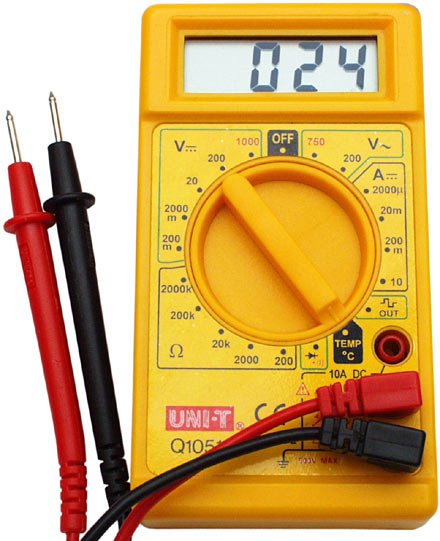
Multimeter, CHEE!!

A multimeter is a device that measures things such as resistance and conductivity!! Woo!

How to use Ohms:
  1. Set the multimeter to Ohms 
  2. Connect black wire to jack that says common or - 
  3. Connect red wire to the Omega jack, or ohm symbol, or letter R next to it
  4. Set the range, if it is provides, to Rx100
  5. Hold the things that stick out of the wires to whatever you want to measure
  6. Measure something like a battery or light bulb


Picture citation: http://www.dansdata.com/images/caselight/multimeter440.jpg